
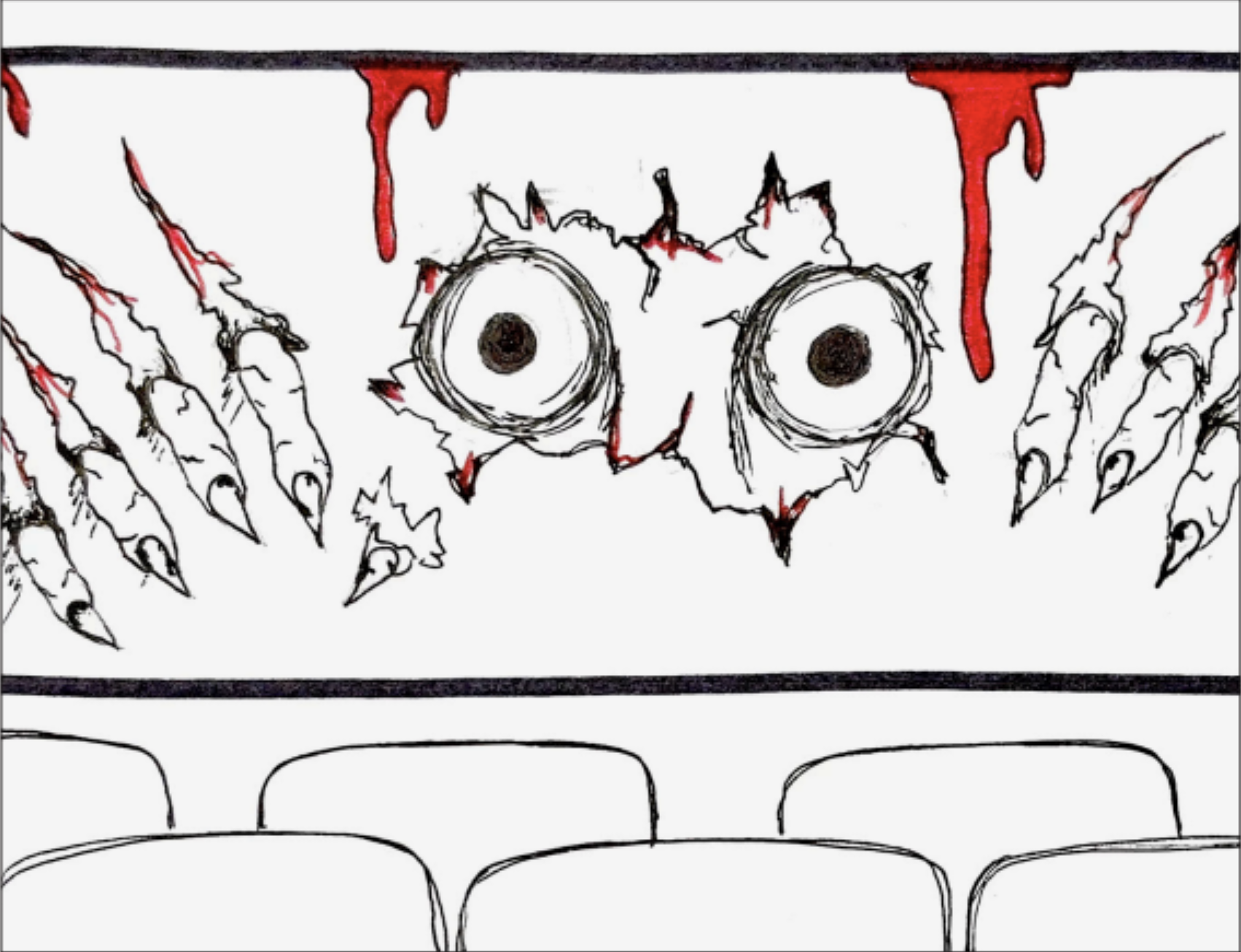
What draws us to horror films–to images to suffering we know will unsettle us–and why do we return to them so willingly?
Sara Mehrabani, a professor of psychology at UCLA who has a doctorate in trauma and interpersonal violence, explains that when we witness violent imagery, even in a fictional setting, our amygdala––the part of the brain that processes fear and responds to danger––is activated because “even though your brain knows that it’s safe, your limbic system does not.”
This is where dopamine comes into play. Dopamine is often referred to as the brain’s “reward” chemical, but it’s more accurate to say it governs motivation and anticipation. It draws us toward something stimulating, exciting, or important. For many people, violent media provides that exact neurological engagement. Mehrabani highlights that watching violent films “allows us to explore life-and-death stakes without ever being at risk ourselves.” That blend of intensity and safety is the genre’s secret. But what happens when the movie refuses to play along?
Michael Haneke’s Funny Games (2007) subverts the horror genre altogether. Released amid the mid-2000s “torture-porn” boom, the film lured audiences with the promise of brutality, only to deny them this spectacle.
The plot of the film is minimal and repetitive: a seemingly typical upper-middle-class family arrives at their lakeside vacation home and are confronted by two unnervingly polite young men, Paul (Michael Pitt) and Peter (Brady Corbet), whose sinister intentions are quickly revealed. They take the family hostage and invent sadistic “games” that escalate in cruelty and psychological torment. But unlike most horror villains, the perpetrators in Funny Games are not given psychological depth or a traumatic origin story; they are caricatures of pure evil.
The movie is not remarkable for its brutality, but instead for the lack thereof—all instances of violence are either off-screen or abruptly cut. When the mother is forced to undress, the frame never leaves her face. When the son is murdered in the living room, the camera stays in the kitchen, reducing the act to an offscreen sound. By denying the visual gratification that horror conventionally delivers, Haneke forces the audience to confront the nature of their own expectations. The missing imagery does not spare us—it indicts us, revealing that our discomfort comes as much from being denied spectacle as from the horror of the events themselves.
After the son’s death, the killers leave, and the film dissolves into an eleven-minute, uninterrupted shot. The mother slowly frees herself, turns off the television, and steps out of frame before returning to cower on the floor next to her husband. The camera holds a fixed, impartial gaze—its stillness and simplicity stripping away all cinematic manipulation. In this brutal intimacy, the audience is forced into the uncomfortable role of voyeur, confronted with the fact that they are simply watching a husband and wife grieve their dead child.
Funny Games strips away the illusion of moral distance, forcing the audience to confront the psychology of their own gaze. Mehrabani identifies this paradox as “benign masochism”: the enjoyment of negative emotions in a safe context. We enjoy experiencing fear when we can control it. Our fascination with horror arises from the same impulse that makes us ride rollercoasters and eat spicy foods: it allows us to experience intense emotions without real-world stakes.
Yet Haneke’s film reminds us of the line between exploring fear and consuming suffering. When violence becomes background noise, we risk dulling our empathy. If we are not careful, the thrill that once helped us process danger can instead normalize it.