
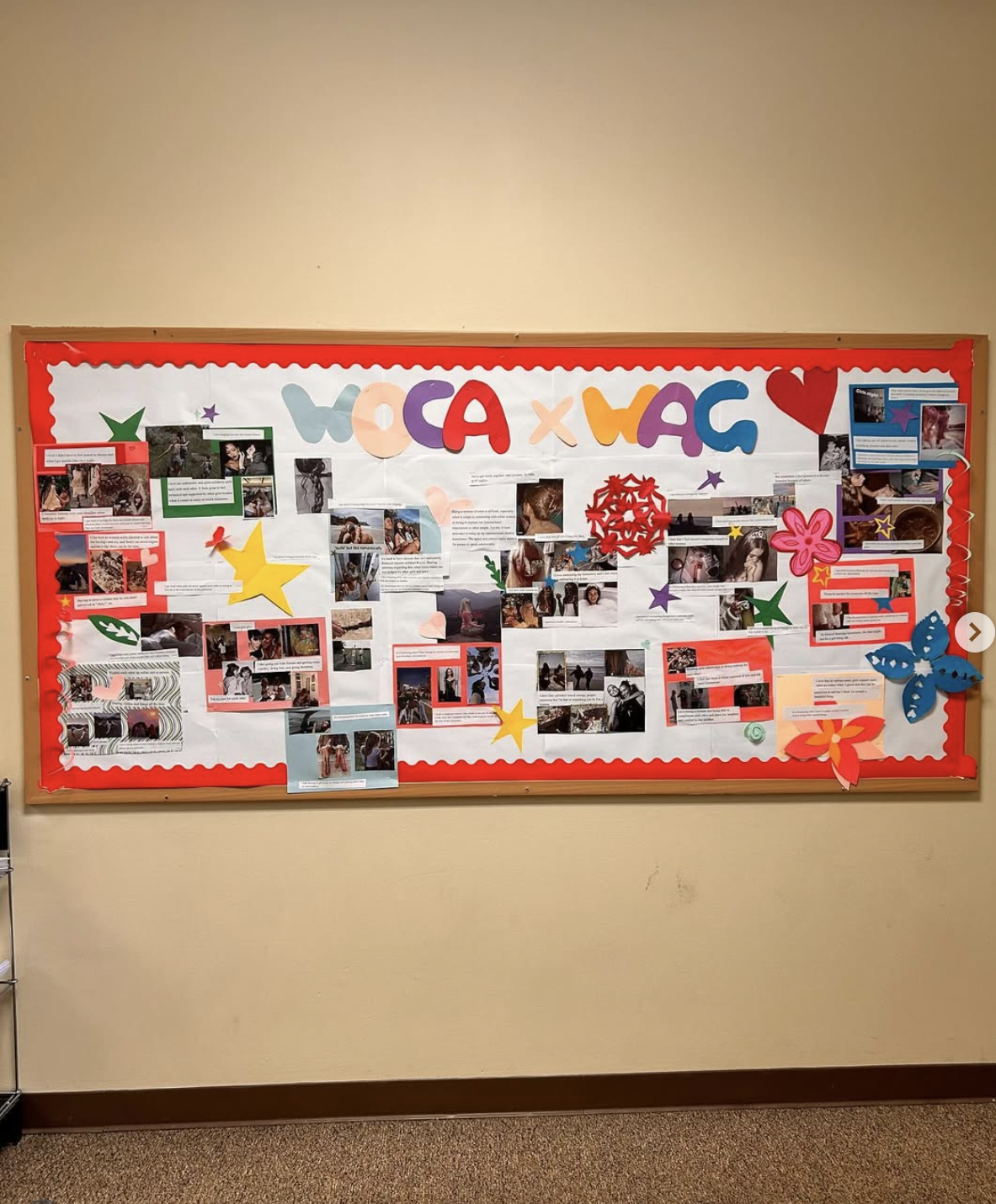
In the Upper School, there are currently two alliance and affinity groups representing women: the Women’s Alliance Group (WAG) and the Women of Color Affinity Group (WOCA), or WAG is a space dedicated to all female-identifying community members and allies, whereas WOCA is specifically dedicated to female and non-binary identifying people of color at the School.
WAG, founded in 2015, has worked over the past 11 years with various alliance and affinity groups at the School and with organizations outside of the School on initiatives seeking to connect with a large demographic of women. These initiatives have included a collaboration with the School’s Muslim, Middle Eastern, and North African Affinity and with the School’s Medical Advocacy Club.
WOCA, founded in 2023, sought to fill a niche that had not been previously served at the School. Senior Maya Pabla, a member of WOCA who joined when it was founded and represented WOCA at the School’s Diversity Council, said, “I wanted to find community outside of just people of my ethnicity.” WOCA offers a space, Pabla said, for students to connect their femininity directly to their race and ethnicity.
WAG and WOCA currently meet at the same time, which is a challenge for both groups. Pabla said, “I do think the scheduling conflict harms both groups because it forces women of color to choose between the two options, and most of the time, they are going to pick WOCA because they know that can connect more of who they are to the space rather than just their womanhood. I don’t think they should be at the same time, and I also definitely don’t think they should be combined into one.”
Both groups have found that their attendance has been hampered by meeting at the same time. Emmy Mitchell, one of the Co-Leaders of WAG, said, “Hopefully the new schedule will be better, but it’s really unfortunate because WOCA either overlaps with WAG or the racial affinity groups. They lose [some of] their demographic either way.”
One of the issues that the scheduling conflict is creating is one of intersectionality. Mitchell says, “We’ve lost a lot of racial diversity in our group, which is devastating because we lose a perspective that increases the intersectional knowledge we gain by listening to other voices.” Members of both groups have expressed a desire to attend the other, but are currently unable to do so.
WAG has partnered with WOCA several times in the time since WOCA’s creation on joint meetings and projects. Elena Malan, a Senior and Co-Leader of WAG said, “[We want to continue] collaborating on things like cookie-decorating events and [affinity] spotlight weeks.”
The importance of these two groups for female and non-binary students at the School is immeasurable, providing safe spaces for community-building, education about women’s experiences and struggles, and self exploration Both fill important niches and are working in tandem on many issues. Despite the scheduling conflict, both groups are offering a safe space for their members; WAG’s leaders have expressed how meaningful the space has been for them, and Pabla said of WOCA, “I found the intersectionality that we all experienced beautiful and a meaningful way that connected all of us.”