
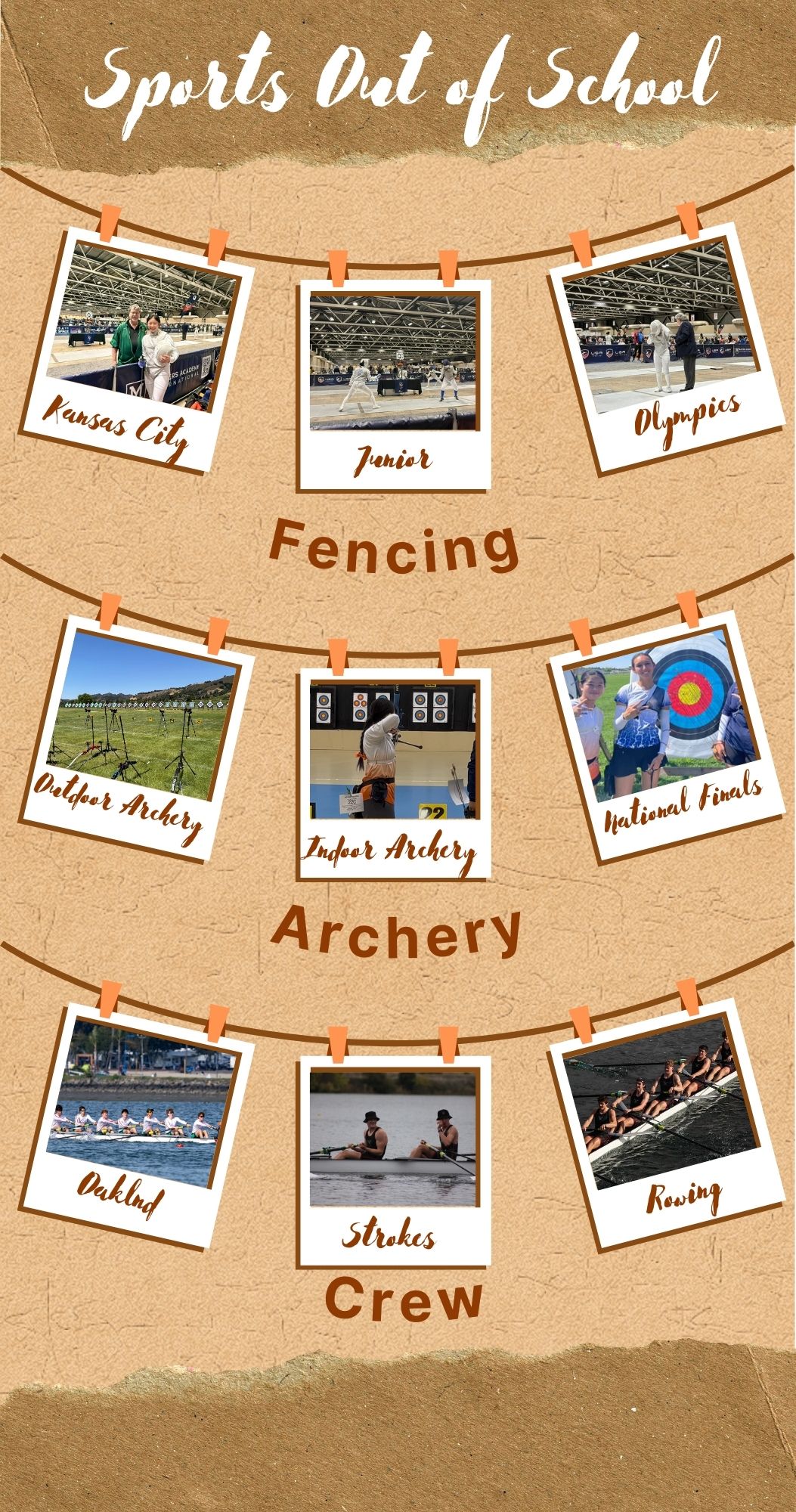
Some students at the School choose to participate in out-of-school sports, including individual activities not offered by the School, such as archery and fencing. These extracurriculars differ from school sports in several ways, including accessibility, time commitment, cost, scheduling, and the availability of a supportive community. Still, these athletes find ways to overcome these challenges in order to participate.
While out-of-school sports can present challenges, they can also offer a level of flexibility and independence that appeals to some students. Maddie Wong, a sophomore who participates in archery, said that scheduling is one advantage of her sport: “For me, with archery, the time is a lot more flexible than I know a lot of other sports are.” However, this same flexibility can also serve as a challenge for out-of-school athletes. Tiffany Zheng, a freshman who also participates in fencing, explains that finding the personal accountability necessary to stay committed without a structured schedule can be difficult. “You don’t really have a set schedule or anything because it’s outside of school. A lot of it comes down to your own commitment, and sometimes it’s hard to find motivation,” she said. These experiences show that while out-of-school sports provide flexibility, they demand a strong sense of personal responsibility and autonomy from the athletes who pursue them.
Another obstacle obstructing athletes’ ability to play these sports is accessibility. Prospective participants may struggle to find environments where they can both compete and develop their skills. Tiffany Zheng notes that limited access often leads to a greater time commitment, saying: “A lot of people that I know who participate in my sport go to a club that’s really far. I go to one that’s relatively closer, but it still takes about an hour to get there.” Accessibility can look different for each athlete, as Wong comments that, rather than being faced with a greater distance/time commitment, “equipment can be very difficult to find, and definitely a little more on the expensive side.” Despite these limitations, both athletes continue to persevere in order to gain the experiences and benefits these activities provide.
Ultimately, athletes pursuing individual sports outside of school face a unique set of hurdles and must find a way to play in an environment where their success is not only determined by their physical ability, but also by their resources and time management. Despite these challenges, many students continue participating because these sports allow them to pursue personal interests and develop skills at their own pace. For some athletes, the independence and self-discipline required become just as valuable as the sport itself. Without the built-in support of a school athletics department, their development in solidarity requires resilience, responsibility, and dedication.