
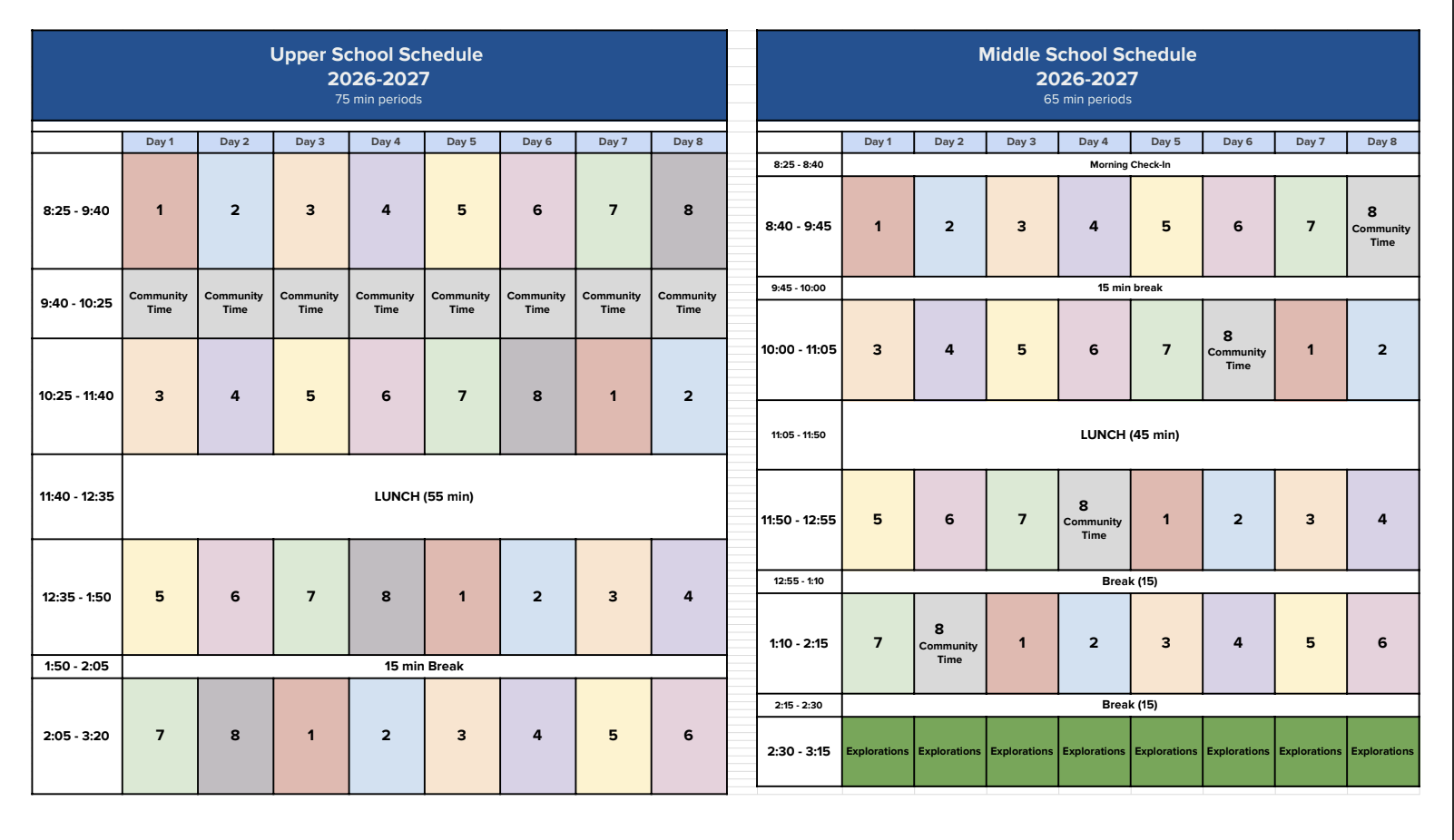
Over the past two years, the administration has been working on a major change to the Upper School schedule: shifting from the current 7-block, 5-day week to an 8-block rotation over 8 days. If adopted, the new schedule would give students more free periods, longer passing periods, a more consistent daily rhythm, and additional opportunities for electives, community time, and college counseling.
The push for change began in 2018 after the School partnered with Challenge Success, an organization that studies student wellbeing. Surveys revealed rising stress levels, lower motivation, and a sharp increase in students reporting they were simply “doing school” instead of feeling engaged.
“Students have been reporting for about 10 years that they’re just going through the motions,” said Mr. Joel Sohn, Assistant Head of School. “We want kids to feel engaged in their learning and that it is exciting for them, rather than just going through the motions of being here.”
The proposed plan includes eight blocks instead of seven. Most students would still take six classes, but with two additional blocks in the cycle, nearly everyone would have at least one free period per day, and often two. According to Mr. Sohn, the goal is “to try to give [students] a free almost every single day.”
That idea is widely appealing; several juniors agreed that it would “give [them] more time to go to Rocky’s or Montclair”, or, as a sophomore noted, “finish up homework before practice” to avoid “staying up late to cram it all in.” Other students welcomed the change simply because, as one put it, “it basically means less school.”
The proposed schedule would also include longer passing periods between classes, designed to ease transitions between the north and south campus. For some, that change feels overdue. “Right now it takes a long time to get to the south campus, and I have a lot of classes on the south,” said junior Kayson Naik.
The schedule would also set aside consistent time for assemblies, clubs, advising, and affinity groups, addressing long-standing student requests for daily community time. In addition, one block could be dedicated to college counseling during junior and senior year, giving students structured time to work on applications without losing a free period. Administrators also emphasized that the rotation would prevent students from missing the same academic class repeatedly for athletics or other recurring commitments, a long-standing issue with the current system.
Teachers, too, may benefit from the shift. With fewer classes to teach each day, they would gain more time for grading, planning, and collaboration. “Hopefully a teacher would only need to teach two blocks a day,” Mr. Sohn explained. “They have much greater open spaces to give better feedback, because [they] have more time to look over student work and prepare for classes … so that the student experience is improved.”
While many welcome the potential for balance, others are cautious about the challenges. Moving from a traditional Monday–Friday calendar to an 8-day rotation could make it harder for students and teachers to keep track of their schedules. “I expect I will be disoriented in the beginning,” said History teacher Mr. Scott. “Because like all human beings, I live on a Monday through Sunday schedule.”
Some students share that concern. “I already forget which day it is sometimes,” said a sophomore, “so if it’s an 8-day rotating situation, that will be super confusing.” Others pointed out that the only way to remember their schedule would be to check their phones, something ironically not allowed under the School’s phone policy, which requires teachers to confiscate devices during the day. River Caruana, a junior, said, “I’ll have to use my phone a lot more to check my schedule,” suggesting that the administration “should probably unban the phones, especially for the first part of the year.”
These worries helped spark a Middle-School-student-led petition that has already gathered over 160 signatures. The petition argues that the proposed schedule “is confusing,” disrupts routines, and makes life harder for teachers, especially those with part-time roles. Instead of a complete overhaul, the petition suggests a simpler fix: moving the daily block of advisory, clubs, or study hall to the end of the day, so that sports and other activities overlap only with electives or PE. “We’re asking the school to rethink the 8-day rotation and instead try small, simple changes that fix the problem without creating new ones,” the petition reads.
However, it’s worth noting that the petition describes an inaccurate schedule, one that places “things like PE, art, band, clubs, and study hall at the end of the day.” This description does not match the actual proposed schedule.
Additionally, teachers with experience with rotating schedules at Lick-Wilmerding noted both advantages and difficulties. English teacher Linnea pointed out that such schedules can make it easier to attend office hours or schedule recurring appointments, because of the allocated community time in the morning. But she also acknowledged the challenge of living on an 8-day cycle while the rest of the world operates on a 5-day week. “Students who were more disciplined and organized did fine,” stated Ms. Jones of her previous school experience at Lick-Wilmerding. “But if you weren’t… it was a nightmare.”
Some teachers raised concerns about logistics, especially for those with childcare or part-time roles that depend on a standard weekly calendar. Others pointed out the potential strain on organizational systems, such as scheduling makeup tests, managing office hours, and keeping track of homework rhythms.
“I’ve been hoping for a long time to have more support around study skills and organizational skills,” said learning specialist Peytra. “If we’re going to participate in the schedule as a community, then I think we need to be fair and provide support around that.”
Despite the extensive planning, the schedule has not yet been finalized. Head of Upper School Mr. Lapidus stated, “Nothing has been formally adopted or announced.” The administration plans to continue testing models, gathering feedback, and preparing teachers before a possible rollout.
Ultimately, the goal is to design a schedule that prioritizes student well-being. “Our number one priority was an improved sense of well-being across campus,” said Sohn. “And so if that’s the result, then I’m all for it.”