
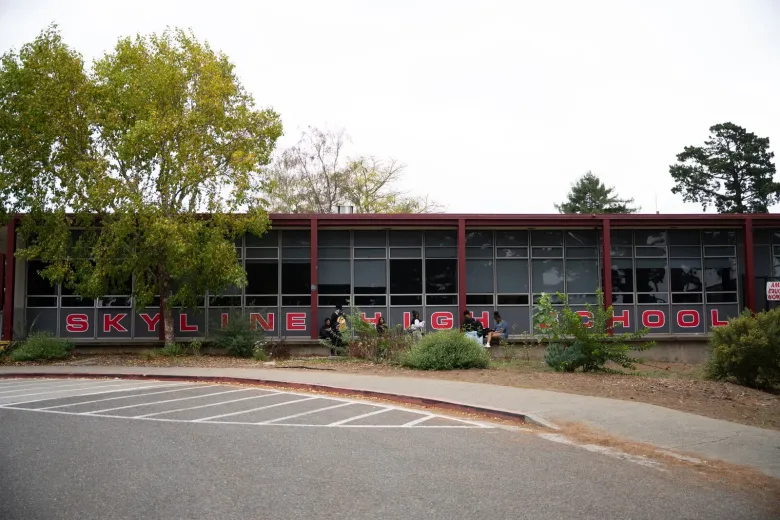
On November 12th, a student at Skyline High School in Oakland was shot. Two students at this school, 15 and 16 years old, brought in so-called “ghost guns”, which are guns that are homemade, 3D-printed, or assembled with kits, and thus are extremely hard to trace. The 15-year-old victim was wounded by his two assailants, but was thankfully given life-saving medical assistance after police made it to Skyline in less than two minutes. OPD Assistant Police Chief James Beere reported that the victim was recovering well and described him as in “good spirits.” Both suspects were subsequently arrested, despite an attempted escape to the roof of the school, where another gun was stashed.
Although the suspects were captured and the incident ended non-fatally, the shooting has shaken Skyline’s community. On November 18, hundreds of students walked off the campus to protest a lack of security against gun violence. “We deserve better,” a student-made announcement read, “We deserve to feel safe.”
On the topic of Head-Royce’s own security protocols, “I think we definitely have a really good protection system for outside threats,” said senior Emmy Mitchell. “[It’s] interesting…that most school shootings happen from students at the school…, but it’s kind of hard to prevent something that could be coming from the inside.”
Despite student fears and apprehension about the School’s security protocols on gun violence, the School does have safeguards. These safety protocols are put together and managed and enforced by Ana Gomez, the Director of Operations.
For the most part, the school protocols around gun violence or other threats coming from inside the community are designed less to stop incidents as they occur, but more to create an environment where these incidents do not occur in the first place. Gomez summarized the policy around school safety: “By no means [do we allow] any weapons on campus per our handbook, and we don’t have any metal detectors…Our job is more to manage suspicious people, and then in the classroom and with student relations, we allow the divisions and administrators to take the lead on that.” The ban on weapons of any sort includes knives, firearms, and fake or toy weapons.
Gomez’s attitude towards the school policy is a positive one. “I think our no-tolerance for any weapons is absolutely great…We do a really good job of creating a culture where we don’t really think that’s a risk.” Gomez added that instituting more severe measures, like metal detectors, might have been “overwhelming,” and “nonproductive” , despite being a contingency set in place for worst-case scenarios.
Gomez feels confident enough in the School’s environment to say that our policies don’t need any changes and talks more about our drills and preparation. She says, “Practice, practice, practice. Our policies are just words on paper, but it’s how students and adults react in case of an emergency that really matters.”
Ultimately, it is hard to measure whether security against at-school violence is effective, because the indicator that security and preventive measures are working is nothing happening, while the only thing that indicates that they are not working is a worst-case incident. So while the School remains safe, students are unsure, wondering if no news really is good news, or if the administration needs to take steps to make the School safer.