
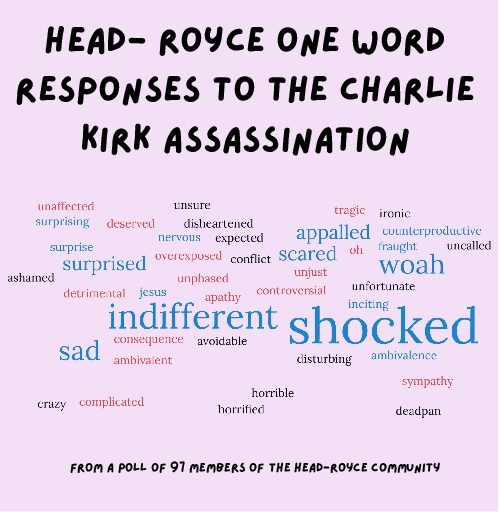
On Wednesday, September 10th, students and teachers at the School learned that Charlie Kirk, a popular right-wing political commentator, was shot and killed during an event at Utah Valley University.
The shooting occurred at the beginning of the School’s lunch period, with videos of the bullet hitting Kirk’s neck quickly circulating among the student body. Less than two hours later, before the end of E block, CNN and other major news sources announced his official death.
Grace Leslie-Waksman, a history teacher at the School, was “horrified” when she saw the New York Times alert on her computer notifying her of Kirk’s death. She witnessed a range of student reactions to the assassination, but noticed two general trends in their reactions. She said that students who were “shown the video [or] hadn’t realized what they were gonna watch. . .were surprised at the horror of it. . . . [whereas] other students [were]. . . reacting to it in a way that was more like we’re watching violence on television.”
There was also a range of students’ outward expressions of their opinions regarding Kirk and his death. Shubh Doshi, a senior and a Co-President of the Politics Club at the School, said, “A student in the politics club reported that a teacher had demonstrated their excitement in front of them about the assassination.”
While the Head of Upper School Ricky Lapidus understands the range of feelings surrounding Kirk and won’t discipline community members for their instinctual response to his killing, he worries about students or faculty celebrating political violence. “Regardless of anybody’s feelings on a person, in this case, Charlie Kirk, I don’t think it’s appropriate or healthy to celebrate a human being’s death,” he said.
Neither Leslie-Waksman nor Lapidus, however, believe that this problem is specific to the School. “It [celebrating Charlie Kirk’s assassination] captures a world that feels incredibly fragmented and bifurcated. . .with people feeling very angry and very scared,” Lapidus said.
Leslie-Waskman believes that the way the news spreads plays a role in normalizing the violence. “Watching something on video can commonly take away the immediate horror of it,” she said. With the internet, graphic videos like that of Kirk’s shooting are easily available to all age groups within minutes of the events unfolding. Especially with social media, violent content can go viral and be pushed on the feeds of unsuspecting users. The prevalence of such violence online can subconsciously lower our feelings of empathy and horror, in turn making events like Kirk’s assassination seem normal.
“We’re in a world that has terrible things happen and people are used to seeing them on YouTube and then they move on to the next thing,” Lapidus said.
Lapidus encourages students to stand up for what they believe in and share their perspectives while making sure to find humanity across political lines. “I want us to be a place that celebrates peaceful dissent, that doesn’t celebrate violence,” he said.
Ultimately, the School’s response to Kirk’s death poses an interesting question: do its students apply their morals consistently, or do they pick and choose who is deserving of compassion and, in this case, life?