
From its beginning, Oakland’s government has been subject to harsh criticism for certain shortcomings, resulting in multiple fundamental changes to its structure.
In 1852, lawyer Horace Carpentier, who lived in what is now Downtown Oakland, proposed that Oakland be officially incorporated into California. The state legislature agreed, and the Town of Oakland was created. The town had only 75-100 permanent inhabitants and was governed by a Board of Trustees, similar to a city council but intended for less populated areas.
In 1854, the state legislature reincorporated the region as the City of Oakland. This reincorporation altered the city’s governing system, switching from a Board of Trustees to a six-person elected common council and adding an elected mayoral role. The council was given a range of legislative powers, including taxation, infrastructure projects, and the creation and regulation of government agencies like police and fire departments. In this system, the mayor could veto ordinances passed by the common council, but the council could override the veto with a two-thirds majority vote. The mayor’s main role was to ensure that the council’s ordinances were being followed, which the mayor could execute as the “head of the police.” Carpentier became Oakland’s first mayor in an election infamous for drawing more votes than there were residents, but was pushed out of office only a year into his term when his constituents learned he had acquired exclusive rights to the city’s waterfront two years before.
This mayor-council system persisted until 1931, when the city removed the mayor’s veto power and placed them on the council as a voting member instead. The most powerful figure in the Oakland government became the city manager, who was chosen by the council and held similar powers and responsibilities as the mayor had previously. Amid fears of the mayor being easily corrupted by third-party interests, continued government inefficiencies and scandals plaguing the city, and the backdrop of the Great Depression, this shift was meant to add accountability.
In 1980, Oakland voters passed Measure H, tying council members to specific districts rather than them each being voted on by and representing the city as a whole. This change was intended to make the city council responsive to their constituents and uplift minority voters concentrated in enclaves around Oakland who, in city-wide councilmember elections, were overpowered by the majority white vote.
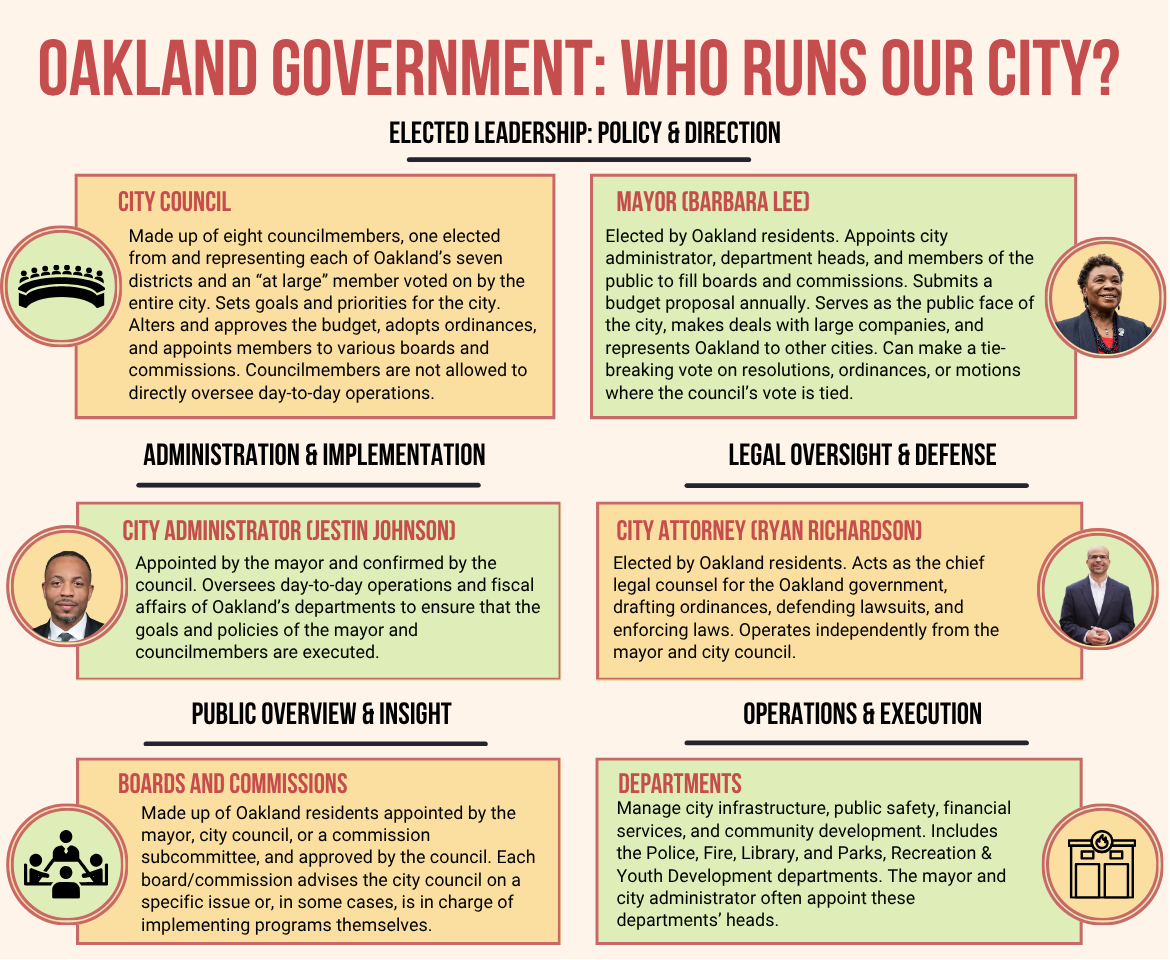
Despite these reforms, Oakland’s struggles remained. In 1998, as Jerry Brown ran for mayor, he championed Measure X to return Oakland to a type of “strong mayor” system it used from 1854 to 1931. But despite its popularity, it has far from fixed the Oakland government. Zac Unger, the current District 1 Councilmember, believes that the system, still in place today, fails to serve its people. “We don’t have a strong mayor system, and we don’t have a strong Council manager system. We have this weird hybrid that has really served us poorly,” he said.
According to Unger, the “council has two roles. One is, we pass the budget, which is huge. . . And number two is we write legislation.” But the problem, as he sees it, is that while the councilmembers are most attuned with the needs of their constituents, the mayor has all executive power. “[W]e don’t effectuate that legislation [we create],” Unger explained. Not only that, he believes that “we have a system of government where the buck stops nowhere, nobody’s really in charge,” he said.
Oakland Mayor Barbara Lee’s working group on charter reform has begun drafting a proposal that would again restructure the city government. After comparing potential strong-mayor and council-manager systems, the group concluded that the former is preferable.
Unger, in contrast, believes that while a strong-mayor setup would be better than the current hybrid, he prefers a return to a council-manager system, which is used by the vast majority of California’s cities. He thinks it would allow council members to more easily solve problems facing their constituents. “[T]he council manager [would] report to me instead of reporting to somebody else. So like, when I bring him a problem, he’s like, ‘Oh, I gotta keep Zac happy, because he’s my boss,’” he said.
Regardless of which system Oakland voters choose if the measure eventually reaches the ballot, it is clear that we need change because—as Unger lamented—“what we have now clearly isn’t working.”