
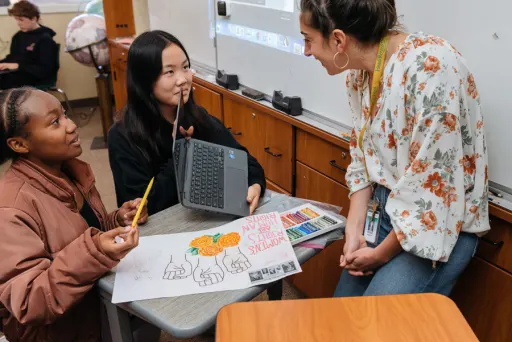
Many teachers at the School have achieved high levels of education and instead choose to teach high school rather than pursue a career in academia. Biology teacher Jen Brakeman, for instance, holds a PhD in neuroscience. In grad school, Brakeman became a teaching assistant (TA) for a neuroanatomy class and discovered her passion for teaching. Teaching at the School was her first job after graduate school, and Brakeman has taught 11th and 12th grade since the early 2000s. She reflects that most of her time in graduate school was spent “researching something a mile deep and an inch wide.” However, Brakeman found that teaching broader lessons to high school students helped her connect the dots between topics. “I actually understand neuroscience better now that I’ve taught it,” she says. Additionally, Brakeman values the stability of her teaching job compared to academia, where one must constantly apply for grants to receive adequate funding.
Bryan Jennewein has received both a bachelor’s and a Master’s degree in English, as well as a doctorate in social sciences. He is currently working on a second Master’s in applied artificial intelligence. He’s never gone more than a few years in his adult life without pursuing further education. “I spent much of my early career working in tech, and I knew that I wanted to make a transition to teaching,” reports Jennewein. He has studied and currently teaches in both STEM and the humanities, and considers himself an interdisciplinarian. “I’ve always enjoyed the opportunity to bring seemingly disconnected things together,” he says. Jennewein was a short-term substitute briefly but began teaching full-time through a connection with Interim Head of Upper School Courtney Duke. Currently, he teaches both Expository Writing and Computer Science courses at the School. “[Teaching] brings me more joy than any other career,” he says.
Chemistry teacher Stella Glogover attended New York City’s prestigious Stuyvesant High School, graduated from NYU with a Bachelor of Science, and advanced to candidacy within the MIT PhD program. She spent six and a half years working towards her PhD, but ultimately decided to write her masters’ Thesis and become a teacher instead. Glogover thinks back on a comment from her advisor at MIT. “He said, ‘The problem with research is that the quanta of success are too large’… And what he meant by that was, you don’t get constant feedback. But in the classroom, I get constant feedback. And that’s really lovely,” she reflects. Glogover, who has taught at the School since 2004, always envisioned her career as revolving around education in some form. “Even when I was in grad school, I was picturing becoming a professor and academic, but that still involved teaching; it was just teaching older people,” she muses.
Glogover, Jennewein, and Brakeman all independently report that their favorite parts of teaching are what Jennewein refers to as ‘a-ha moments’: the times when they can clearly see that a student understands a concept or is piecing together aspects of the course material. While different teachers come to the School with a variety of backgrounds and reasons, teachers who chose this career path and later became passionate about educating others are a particularly special part of the School.