
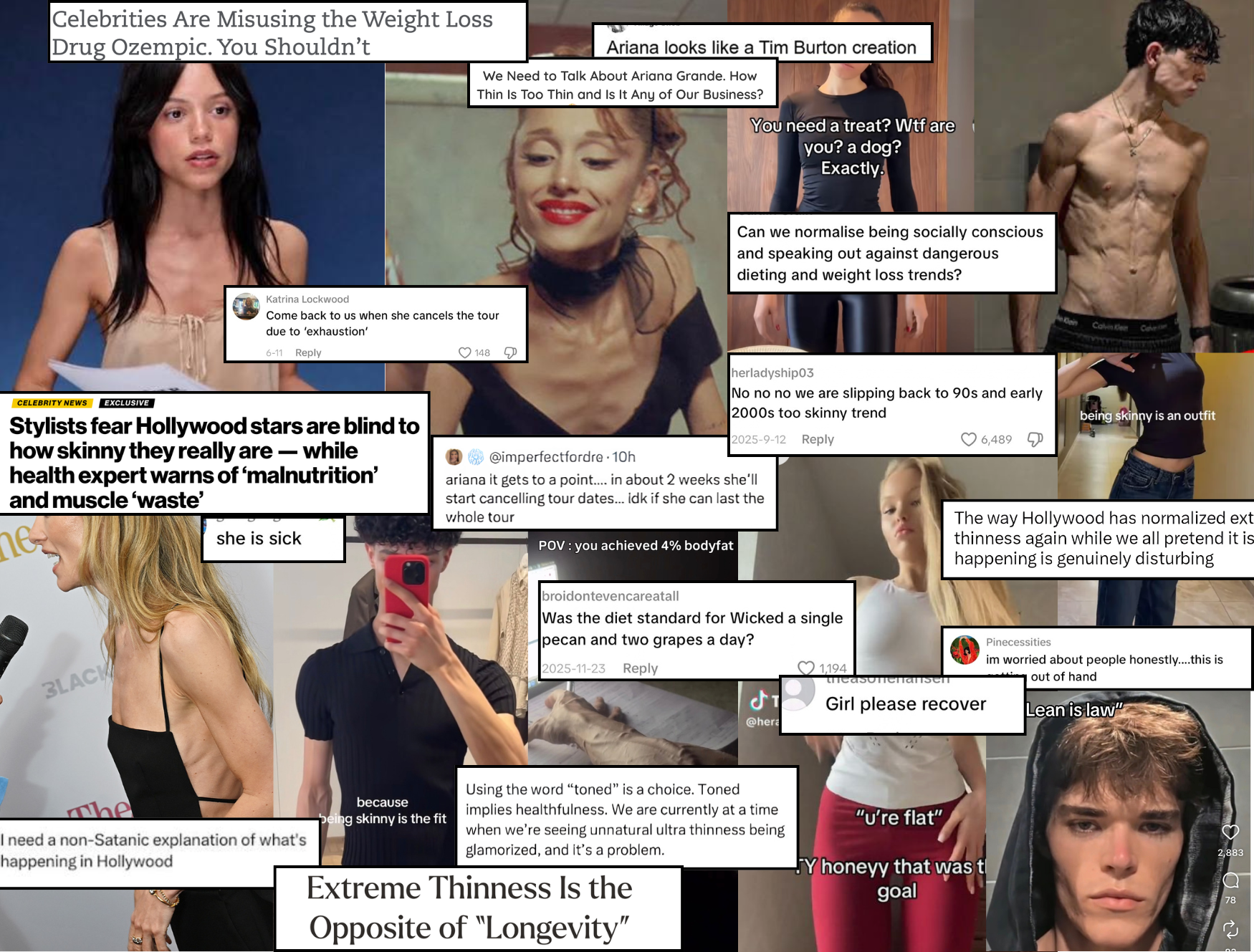
In recent years, there has been a shift away from the body inclusivity of the 2010s and society is seeing a rise in skinny culture. Many factors drive the rise in promoting thinness, including social media, celebrity influence, and weight loss medication. Skinny culture is “based almost entirely on appearance and not on physical health or fitness.” This is a definition given by Hannah Niles, a dean and ninth-grade health teacher at The School.
The 2010s were characterized by body positivity; there were more plus-sized runway models, curvier people in mainstream media, and fewer dangerously thin bodies. Throughout history we see that fashion and culture become popular again on a 20-year cycle. Following that cycle, we are back to early-2000s fashion and beauty standards, and young people and celebs are facing the same heavy pressure that characterized that era.
Singer and actress Ariana Grande’s extreme thinness has been a recent topic of conversation online. Freshman Mali Manning expressed her concern, saying, “I am concerned about her and her eating habits and how that might contribute to young women’s view of what their body types should be.” The scrutiny against her body got so extreme that she announced she is taking a step back from public life. This has been the case for many other celebrities right now, including actors Demi Moore and Selena Gomez. Throughout her more than 40 year career, Moore’s body has been under scrutiny by the media and public. Gomez has faced intense pressure from the media about her body. Although her weight fluctuations are due to health conditions, Gomez has felt intense judgement from the public, especially since her sudden and dramatic weight loss.
As the 2000s make a comeback in fashion and culture, so do its toxic beauty standards. During that time, body dysmorphia was incredibly normalized, and dangerously thin bodies were encouraged as the standard in the media. With fashion choices like low-rise jeans becoming popular, young people, especially, were expected to meet the impossible supermodel standard of heroin chic. Heroin chic was the coveted fashion look from the late 90s to the mid-2000s. Popularized by supermodels like Kate Moss, heroin chic romanticized sickly, emaciated bodies, which are traditionally associated with drug use. This trend was a dangerous beauty standard, especially for young people, because it is impossible to meet it while being healthy and nourishing your body. Trends and ideals like this continue the idea that people need to look a certain way to wear certain clothes and feel good about themselves, when really, that couldn’t be further from the truth.
In an interview, Andie Patterson, the Lower and Middle School Drama Teacher and Upper School Costume Designer, said, “Trends are just designed to sell us things…(the ideal image) is a moving target.” We can never really live up to the expectations society puts on us to look a certain way because those expectations are changing faster than ever with social media.
Teens spend a lot of time on social media every day, on average 4.8 hours (American Psychological Association). Sarah Korsunsky, one of the Upper School Counselors, shares that, “Teens are comparing themselves to the images that they see, many of which are not realistic, healthy, or accurate.” Niles shared that teenagers haven’t accurately been taught that someone’s appearance doesn’t correspond with how healthy they are; teens have been under the impression that healthy is equal to skinny. A study found that “Body image (of teens) was significantly more negative after viewing thin media images than after viewing images of either average size models, plus size models or inanimate objects” (National Library of Medicine). Teens spend so much time on social media watching videos of other people participating in unhealthy trends and habits. Teens are scrutinizing their own appearances without knowing whether that photo is edited or if the person is healthy, because thinness has been advertised as the ideal body type by the media. Patterson said, “Focusing on your weight and body takes away your ability to grow and function publicly as a person”, describing the all-consuming nature of body image that has come back.