
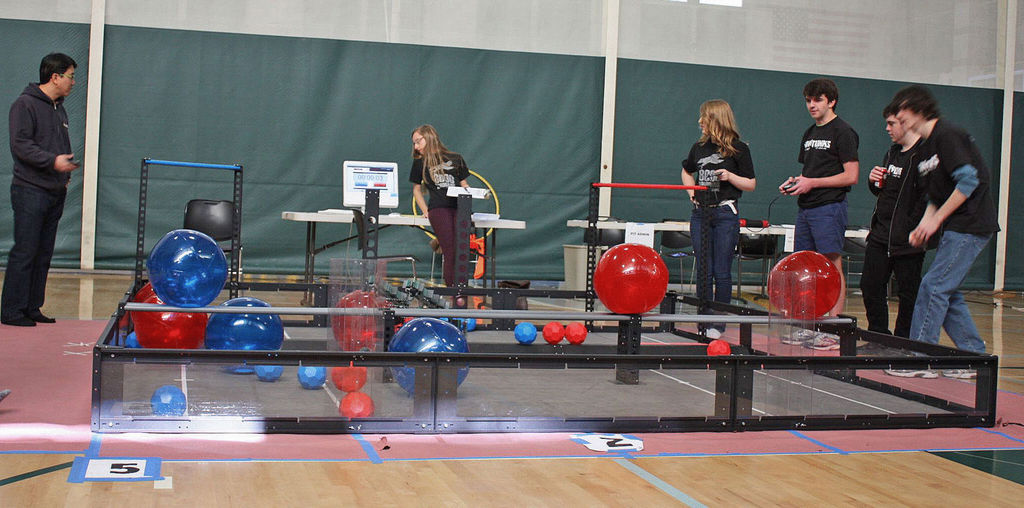
After a weaker-than-usual season, members of the School’s robotics team, the Robohawks, say limited practice time on South Campus played a major role in their performance.
Two sub-teams, Team 8000C and Team 8000X, competed in the California Region 2 VEX State Championships in early March. Although Team 8000C advanced to the semifinals, senior Jonathan Earp said the result was still “less” than what the program typically achieves. The Robohawks also failed to qualify for the World Championship, breaking a 14-year streak.
Earp pointed to a key reason: “We’ve been limited a lot more on the time that we can spend actually doing robotics.”
In previous years, the team practiced in a rented, off-campus space on Lincoln Avenue, where students could work for extended hours. “We’d be able to be there from right after school to 3 a.m., 5 a.m., whenever we wanted,” said junior Gabe Bang.
This year, the team operates under stricter, on-campus rules. Practice is limited to a few supervised hours after school, and coaches must be present. Earp said he spent about ten hours per week on robotics this season, compared to twenty-five hours last year. Other members reported similar decreases.
To work around this, junior Vihaan Goplani said members brought robot parts to each other’s homes, but commute time, parent availability, and limited equipment made this difficult. “The output of work that we do is significantly less,” he said.
The shift stems from city regulations requiring adult supervision when students are on campus. While team members raised concerns with administrators, extending hours would require the coaches to be present for those hours.
Coach Roy Nyberg said the shift was necessary to promote student time management. “In terms of balance, it was a successful change,” he said, noting coaches held a firm line when concerns were raised from the team.
Some students disagreed. “I don’t think the administrators, and even the coaches, really get what it takes to be a good robotics team, and how much time it takes,” said Earp. Sophomore on the team, Cole Hallstein added on, saying, “I think that they prioritize the image of the robotics team without actually caring about how well they do.”
Reduced time has affected the program more broadly, with students leaving to form independent teams to get around these restrictions. Goplani said this created a “talent vacuum” as experienced members departed.
Despite challenges, team members remain optimistic. With younger students gaining experience and others stepping into leadership roles, they expect improvement next season. For now, practice limits remain, leaving what Bang called “a tricky situation.”